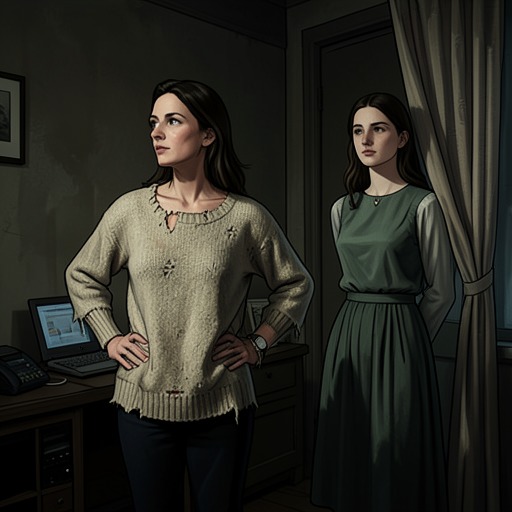
Richard Doss and Eric Doss
Dr. DeathThe relationship between Richard Doss and Eric Doss is shaped by a family’s inability to control Joanne Doss’s illness or undo her death. Richard’s guilt and forceful habits collide with Eric’s grief and anger, culminating in a fight amid the wreckage of the family’s antique collection. Their reconciliation is intimate but not conclusive: Richard holds his exhausted son, and Eric asks for forgiveness, while the causes of their pain remain only partly spoken.
Family Background and Shared Grief
Before Joanne became ill, Richard and Joanne were active together, jogging, dancing, playing tennis, and traveling. As their daughter Stacy Doss explains to Alex Delaware, Richard was always moving, thinking, and doing; when Joanne stopped living as she had before, he was left alone with a life that no longer worked the same way. Her illness drove him to frustration, and the family’s changed circumstances became a source of strain between father and son as well as between husband and wife.
Richard’s sense of failure is rooted in a powerful idea of family obligation. Eric describes his father as a self-made man from an immigrant household: Richard’s father was Greek, his mother Sicilian, and they ran a grocery in Bayonne, New Jersey. Eric’s account dwells on the close-knit domestic world associated with that background, then contrasts it with Richard’s feeling that he had failed to save his wife. The specific source of his guilt is not presented as something Eric can settle. When asked whether Richard could have prevented Joanne’s death, Eric rejects the question as impossible to answer, exposing how little certainty the family has about what might have been done.
Eric and Richard also respond differently to what they cannot control. Stacy says that she was not angry at Eldon Mate as Richard and Eric were; she characterizes their anger as a “Big male thing,” an urge to crush what they could not master. Richard’s violent language about people he disliked, Stacy says, was often rhetorical: he joked about pulverizing a business adversary or wiping him off the planet. That explanation complicates any literal reading of his threats, but it also identifies a family pattern in which anger stands in for helplessness. Eric calls Mate pathetic and a loser, while insisting that Joanne would have continued to decline with or without him.
Guilt, Control, and Concealed Distress
Richard’s grief takes the form of guilt and action. During Alex’s questioning, a possible reason for Richard’s hatred of Mate is raised: Richard may have seen Mate as taking something that belonged to him. The suggestion connects his possessiveness to Joanne, but remains an interpretation rather than a proven explanation. Alex also recalls Richard passing cash to Quentin Goad, giving the father’s claims about seeking closure a darker context. The evidence does not make Richard and Eric’s relationship a simple contest between an innocent son and a guilty father; instead, their family life is caught in the pressure of what Richard may have done and what Eric may know.
Eric’s distress is not readily visible in the family’s account of him. Richard tells Alex that Eric is fine and a great kid, then collapses into the couch and rubs his eyes. Alex recognizes the gap between that reassurance and the circumstances confronting the family: Joanne has died, and Richard has been taken in by the police. Later, Judy Manitow suggests that Stacy was kept out of what was happening, while Eric, who left school to care for his mother, may have known more. She does not claim to know exactly what Joanne told him; Eric may have understood only that his father could not forgive her for something she had done. The possibility leaves his silence charged with a knowledge the narrative does not fully disclose.
Richard’s own composure proves similarly vulnerable. When Alex questions the arrangements for the children while Richard is in trouble, Richard’s face darkens, his chest heaves, and his eyes bulge. He works to cool himself, marking off seconds with his finger before accepting Alex’s description of the arrangements as well-paid babysitting. He insists that the important thing is that the children get what they need. The effort at restraint shows a father still focused on providing for his family, but also one whose anger can surge when he feels judged or exposed.
The Fight Over the Collection
The conflict becomes physical when Alex arrives to find Richard confronting Eric in the living room. Eric holds a baseball bat; behind him, the display cases have been ravaged. Their brass is dented, the glass doors splintered, and pieces of the family’s pottery lie among shards on the floor. Little horses, camels, and human figures have been reduced to rubble. The destruction is not merely a backdrop to the argument: Eric has struck at objects kept in his father’s home, turning a family confrontation into damage that can be seen and touched.
Richard shouts at his son and advances. When Eric swings again at the porcelain, Richard rushes him and grabs for the bat. They struggle over it and fall to the floor, their black clothes gathering glass and dust. Alex dives in to seize the bat; fragments bite into his knees, and a fist lands on his jaw while he maintains his grip. Eric and Richard continue growling and flailing. The scene makes their conflict more than a difference of temperament or a dispute over Joanne: for a moment, father and son are physically entangled in the destruction, each unable to stop the other without force.
Once the immediate violence has passed, Richard asks Eric what he has done to deserve this. Eric first mumbles, then apologizes: “Sorry, Daddy. Sorry, sorry, sorry.” Richard begins to move toward him, but thinks better of it and sits back down. Eric’s repeated apology does not explain the destruction or settle its causes. His next words, “Forgiveness is all,” give the scene a more difficult meaning: the son is not offering a factual account of the fight so much as naming what he wants between them. Richard turns pale and picks up a fragment of a green-and-blue pottery horse. The broken object keeps the cost of the confrontation in view even as the possibility of reconciliation appears.
Reconciliation and Aftermath
Later, after the debris has been partly swept into piles, Richard and Eric sit on the floor with their backs against a sofa. Richard has his arm around Eric’s shoulder; Eric’s tear-streaked face rests against his father’s chest, eyes closed. The image recalls a religious Pietà, but here the father holds the living son. Richard says Eric is tired and that he needs to put him to bed, remembering how he cared for him as a little boy and told him stories. The recollection returns their relationship to an earlier form of paternal care, without suggesting that the losses or injuries between them have vanished.
In the later account, the family appears to have continued beyond the crisis. Stacy reports that Richard is busy all the time and complains about visiting his probation officer, while Eric has changed his major to psychology. His probation is described as the consequence he received, and Stacy regards him as fortunate that it went no further. Eric’s new direction may suggest that the experience affected him, but the text does not state that the fight alone caused the change. Stacy also says that guilt is not a large part of Eric’s life, a pointed contrast with the remorse he displayed while apologizing to his father.
The relationship’s ending is therefore a limited, embodied reconciliation rather than a complete explanation. The embrace and Richard’s memory of putting Eric to bed show their capacity for tenderness beneath anger and estrangement. Yet Eric’s apology, Richard’s unspoken guilt, and the battered pottery remain in the same scene. Their bond survives not because the family’s history becomes clear or harmless, but because father and son can briefly return to care for one another amid its wreckage.